The US$ 60 chip holding your next GPU hostage
The RTX 50 Super is built, boxed and sitting still because one memory module tripled in price. And the memory crisis only slowed down because buyers stopped being able to pay.
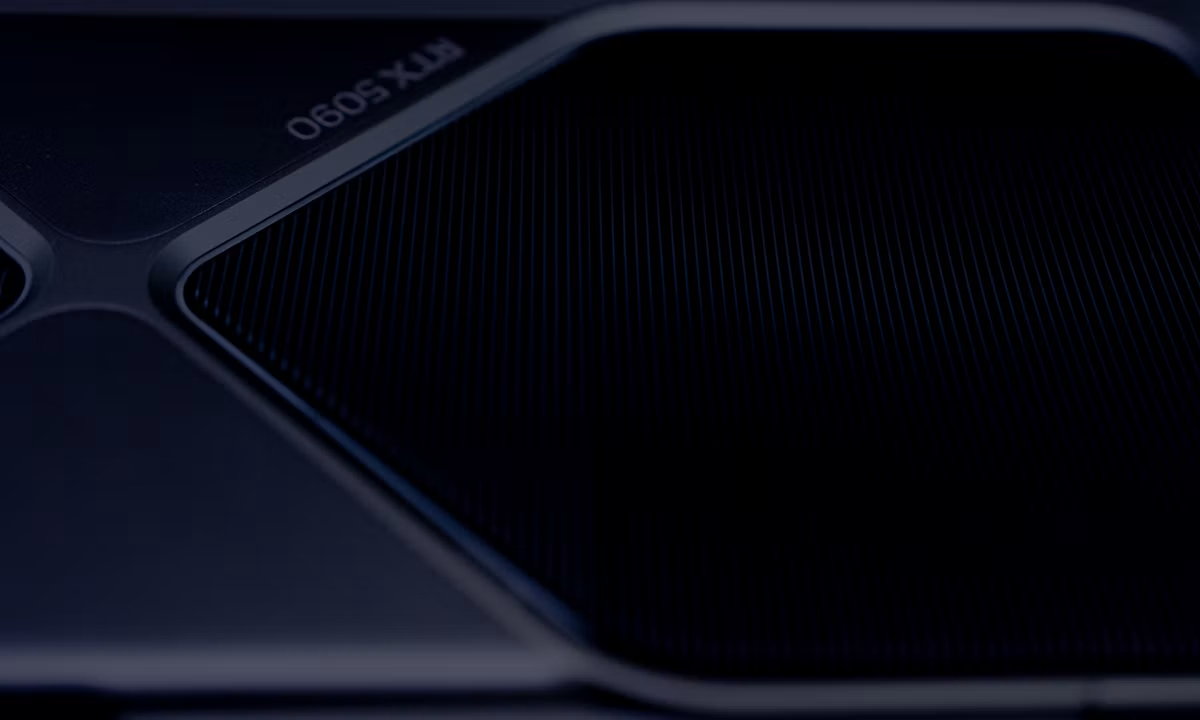
There is a graphics card that is finished, manufactured, boxed and going nowhere. According to hardware press reports, at least one Nvidia board partner has already received physical RTX 50 Super units, and the instruction that came with them was: do not launch.¹ ²
The reason is not the GPU silicon. It is a memory chip the size of a fingernail.
In July we wrote about how the AI race turned memory into the invisible tax on consumer electronics, pushing up the price of consoles, laptops and SSDs. A month later the bill climbed the food chain and reached the component PC buyers watch most closely. This time the damage isn't only to the price. An entire product line never leaves the warehouse.
The 3 GB module that costs three times more
The Super line exists for a simple reason: more VRAM in the same price bracket. VRAM is the memory on the graphics card itself, where game textures and AI models have to fit whole; when they do not fit, performance falls off a cliff. To reach 18 GB or 24 GB without redesigning the board, Nvidia needs 3 GB GDDR7 modules, denser than the 2 GB parts in use today.
Then comes the price. Industry reporting puts the 3 GB module at US$ 60 to US$ 70, against roughly US$ 20 for the 2 GB part.¹ ² Not 20% more expensive: triple, for capacity that buyers expected to get almost for free in a mid-generation refresh.
Add the alternative destination for those same chips: AI accelerators with far better margins. When an identical part can go into a professional card that sells for ten times as much, the priority queue sorts itself out. The practical result is a generation of cards Nvidia finished designing, sent to manufacturing, and then parked.¹ ²
Nvidia hasn't confirmed any of this. These are supply-chain reports published by specialist outlets, consistent with one another, which is how this kind of information travels in hardware before it becomes an official statement.
The bill also landed on the cards that already exist
If you weren't waiting for the Super, the news isn't any better. Specialist outlets report that Nvidia raised the prices of the memory kits it sells to board partners, first on the top models and then across a wider slice of the GeForce line, covering both GDDR6 and GDDR7 products.³ A more expensive memory kit for the manufacturer means a more expensive card on the shelf, with or without a change to the official suggested price.
Suggested pricing, incidentally, has become polite fiction. The RTX 5090 is still listed at US$ 1,999 and still sells well above it. Since the start of the year, market analysts have been describing coordinated increases from Nvidia and AMD driven by memory costs.⁴
The nature of the problem changed along the way. In 2023 and 2024, an expensive card meant gamer demand, mining or a chip fabrication shortage. In 2026, the card is expensive because the memory it carries is worth more somewhere else. It is the same logic that raised the price of your RAM kit, with a scale problem attached. Run the numbers using the module prices in those reports: a card with eight modules goes from 16 GB at roughly US$ 160 of memory to 24 GB at US$ 480 to 560. Same board, same bus, triple the memory cost to deliver 8 GB more.
The curve slowed down, and the reason is bad
One piece of news looks good and isn't. TrendForce, the firm that tracks memory contracts, projects a 13% to 18% increase in conventional DRAM and 10% to 15% in NAND for the third quarter of 2026, a gentler pace than previous quarters.⁵ ⁶
The explanation isn't better supply. It's the opposite: the same firm points out that contract prices hit records and that PC and smartphone makers have reached the limit of what they can pass on. In July, the NAND wafer market essentially stalled, with flat prices and very low transaction volume.⁵ When prices stop rising because nobody is buying, that isn't relief. It's demand destruction.
For the person at the checkout, the distinction is concrete: the brake came from wallets giving up, not from chips showing up. If AI demand holds and consumer demand recovers, prices resume climbing without needing any new development.
The industry's answer exists, and it has the wrong date
On August 4, at the Future of Memory and Storage show in Santa Clara, Samsung played its card: V10 BV-NAND, the industry's first flash memory with more than 400 layers, built with a wafer-bonding technique where the memory cells and the control logic are fabricated separately and then bonded together. The announced density gain is roughly 58% over the V9 generation, with better read, write and I/O performance.⁷ ⁸
The same presentation introduced zHBM, which stacks high-bandwidth memory directly on top of the AI accelerator with a promise of ten times the density and around eight times the performance of HBM5, plus zNAND-O for edge AI.⁷
It's impressive engineering, and from the point of view of anyone buying a PC this month, it's the right answer to the wrong problem. A trade-show announcement is not shelf inventory. Higher density per wafer means more gigabytes from the same slice of fab capacity, which does address part of the bottleneck, just in the following cycle. Memory makers keep repeating that the squeeze runs through 2027, with normalization somewhere around 2028.
And the innovation is pointed elsewhere. V10 BV-NAND, zHBM and zNAND-O are products designed for AI infrastructure. The memory in your computer remains a byproduct of that priority.
What to actually do about it
No advice here will lower a price. It can make the decision less bad.
If your card is good, keep it. A 4070, 4080, 7800 XT or equivalent still handles 1440p comfortably. Upgrading in 2026 means paying a memory premium without a matching gain in frames.
If you have to buy, look at VRAM before the model number. An 8 GB card in 2026 is a short-lived purchase, for a reason that goes beyond games: running AI models locally depends on the model fitting entirely in the card's memory. Between two similarly priced options, the one with more VRAM ages better.
If you are building a PC, reorder your purchases. RAM and SSDs are the most volatile items in the cart right now. Buying the CPU and motherboard now and the memory later is betting against the trend of the year.
If you buy outside the US, remember the increase arrives multiplied. An international hike lands with shipping, import duty, margin and currency risk stacked on top, so every memory kit adjustment abroad becomes a much bigger number in a local store.
What both sides are saying
In hardware forums, the argument splits along predictable lines, and neither side is silly.
On one side is the view that Nvidia is a bit too comfortable. The Super was supposed to be the refresh that restored decent VRAM to the mid-range, and holding that line back while the modules go to high-margin AI products is a commercial choice, not a law of physics. People making this argument point out that the company has been rationing VRAM in the mid-range for generations, long before this crisis.
On the other side, the structural argument: no board maker controls the price of an input whose demand was multiplied by an entirely new market. If the same chip is worth more in a server, it goes to the server, and that holds for Nvidia, AMD and Intel alike. Delaying a line that would ship at negative margin is a boring decision, not a conspiracy.
Both readings fit the same facts, which is what makes this moment uncomfortable: the company can be opportunistic and genuinely supply-constrained at the same time.
Verdict
The 2026 memory story has three acts and we are in the third. First prices rose at wholesale. Then they reached retail, making consoles, laptops and SSDs more expensive. Now they decide which products exist at all: an entire graphics card refresh built and parked because a 3 GB module costs triple the 2 GB one.
The most honest signal of the month is the reason prices slowed, not the slowdown itself. Increases got smaller because buyers hit their ceiling, not because spare memory appeared. Meanwhile, the most advanced thing the industry has to show, with 400 layers and stacking directly onto accelerators, is built for data centers and reaches your cart a cycle later.
For anyone building a PC, it fits in one sentence: in 2026 you're not buying performance, you're buying memory, at the price AI set. The upside is that postponing an upgrade has never been easier to justify.
Sources
- NVIDIA RTX 50 SUPER cards already at board partners, but launch is on hold over 3GB GDDR7 pricing · VideoCardz · https://videocardz.com/newz/nvidia-rtx-50-super-cards-already-at-board-partners-but-launch-is-on-hold-over-3gb-gddr7-pricing · 2026.
- GDDR7 Shortage Could Stop NVIDIA GeForce RTX 50-Series SUPER Rollout · TechPowerUp · https://www.techpowerup.com/342705/gddr7-shortage-could-stop-nvidia-geforce-rtx-50-series-super-rollout · 2026.
Show 6 more sourcesHide sources
- NVIDIA Reportedly Raises GDDR6 and GDDR7 Memory Kit Prices for RTX GPUs · TechPowerUp · https://www.techpowerup.com/351018/nvidia-reportedly-raises-gddr6-and-gddr7-memory-kit-prices-for-rtx-gpus · 2026.
- NVIDIA, AMD Reportedly Plan Price Hikes Starting 1Q26; GeForce RTX 5090 May Reach $5,000 · TrendForce · https://www.trendforce.com/news/2026/01/05/news-nvidia-amd-reportedly-plan-price-hikes-starting-1q26-geforce-rtx-5090-may-reach-5000/ · 2026-01-05.
- AI Server Demand Continues to Support Memory Prices in 3Q26, but Gains Moderate as Consumer Demand Weakens and High Base Effects Take Hold · TrendForce · https://www.trendforce.com/presscenter/news/20260703-13134.html · 2026-07-03.
- DRAM and NAND remain more expensive: TrendForce sees slowing but still rising memory prices in Q3 2026 · Igor's Lab · https://www.igorslab.de/en/dram-and-nand-remain-more-expensive-trendforce-sees-slowing-but-still-rising-memory-prices-q3-2026/ · 2026-07-08.
- Samsung Unveils Next-Gen 3D-Memory Vision at FMS 2026, Charting the Future of AI Infrastructure · Samsung Semiconductor · https://semiconductor.samsung.com/news-events/news/samsung-unveils-next-gen-3d-memory-vision-at-fms-2026-charting-the-future-of-ai-infrastructure/ · 2026-08-04.
- Samsung Unveils Industry-First 400+ Layer V10 BV-NAND; Memory Density Up 58% vs. V9 · TrendForce · https://www.trendforce.com/news/2026/08/05/news-samsung-unveils-industry-first-400-layer-v10-bv-nand-memory-density-up-58-vs-v9/ · 2026-08-05.
— Redação