There's a Yellowstone under Tuscany
Scientists mapped 6,000 km³ of magma under Tuscany using the planet's own background noise. The find explains why the world's oldest geothermal plant has run since 1904, and it lands while AI buys power that never sleeps.
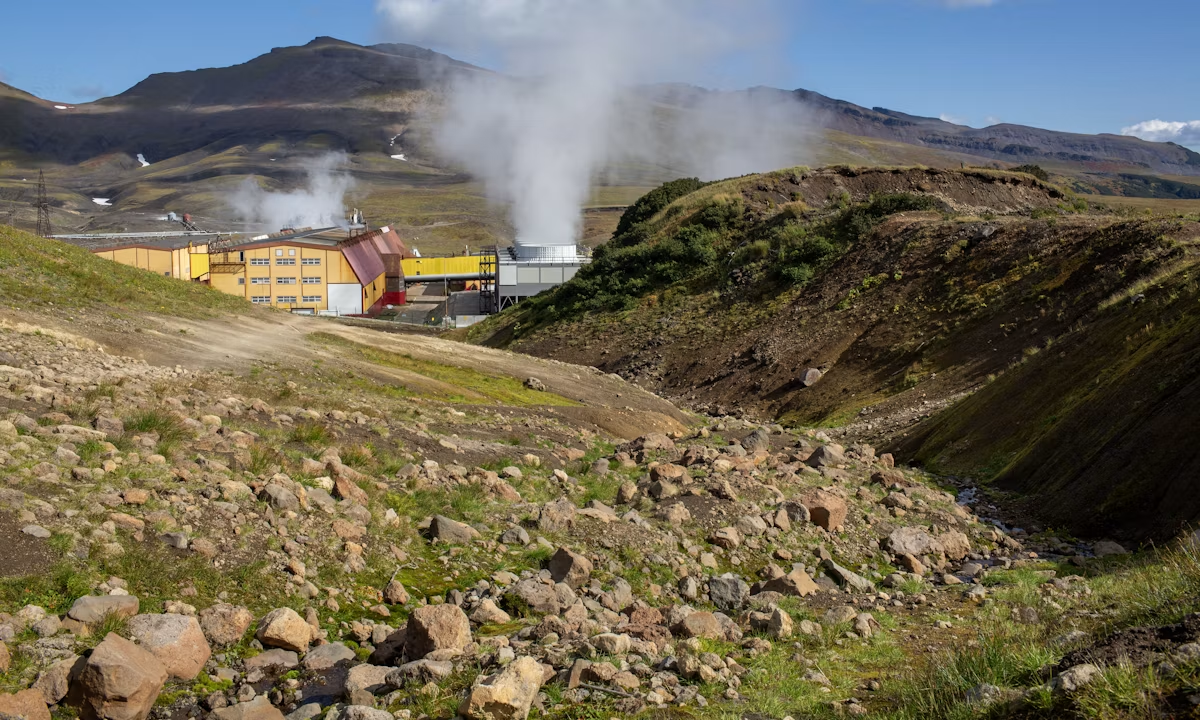
In 1904, an Italian prince named Piero Ginori Conti hooked a 10-kilowatt dynamo to the steam rising out of the ground at Larderello, in Tuscany, and lit five light bulbs.¹ It was the first time anyone made electricity from the Earth's heat. By 1913 the site had the world's first commercial geothermal plant, rated at 250 kilowatts, powering trains and nearby villages.² Today the site comprises 34 plants run by Enel Green Power, about 1,100 megawatts installed and roughly 6 terawatt-hours a year.²
One hundred and twenty years later, somebody finally took a proper look at what sits underneath.
The answer arrived in April in Communications Earth & Environment: a magma body of roughly 6,000 cubic kilometers, between 8 and 15 kilometers deep, comparable in volume to the Yellowstone system.³ ⁴ It had been there the whole time, with no cone, no crater, no dramatic fumarole, under one of the mildest-looking landscapes in Europe.
How you see magma without drilling
The technique is called ambient noise tomography, and the idea behind it is elegant.
The Earth is never quiet. Waves hitting the coast, wind, traffic, industrial machinery: all of it generates a constant faint background vibration, the kind of signal a seismologist normally discards as noise. The trick is to use that noise as the flash for a scan. Vibration travels more slowly through hot, partly molten rock than through cold solid rock. Spread sensors across the surface, measure precisely how long the noise takes to cross each stretch of the subsurface, and you can build a three-dimensional map of where the rock is soft.
The team from the University of Geneva, CNR-IGG and INGV used about 60 high-resolution sensors across the region.³ ⁴ No drilling, no explosives, no heavy equipment: just patient listening to a sound the planet already makes for free.
The result matters beyond geological curiosity. As Matteo Lupi, who led the work, puts it, the method serves both fundamental research and practical uses such as "locating geothermal reservoirs or deposits rich in lithium and rare earth elements".⁴ The same technique that found the magma can also say where drilling is worth it, and where it is not.
Should you worry about a supervolcano?
No. But it's worth saying why, because the word "Yellowstone" sends most brains straight to the disaster movie.
The authors are explicit: while this magma body could in theory contribute to forming a supervolcano over geological timescales, it poses no current threat.⁴ Depth helps. Magma sitting 8 to 15 kilometers down, partly crystallized, with no open path to the surface and no sign of rapid recharge, is a slowly cooling system, not a pot about to boil over.
What the study changes is the understanding of the engine. Larderello was always treated as an unusually hot geothermal anomaly, and now we know where all that heat comes from: a volume of molten rock far larger than assumed, sitting right below.
Why a magma map matters to a data center
AI data centers need firm power: power that works at three in the morning, in winter, with no wind and no sun. Solar and wind are cheap and clean but intermittent; batteries solve hours, not seasons. Geothermal is the renewable that runs 24 hours a day regardless of weather, which is why it became an object of desire for the companies building AI capacity.
This is not a talking point. The contracts are signed.
- Google started small, with Project Red, a 3.5-megawatt pilot run by Fervo Energy in Nevada, which came online in November 2023 and began feeding carbon-free electricity to the grid serving its data centers.⁵ The pilot turned into a real contract: utility NV Energy now delivers 115 megawatts of round-the-clock enhanced geothermal to Google's operations in the state.⁶ ⁷
- Meta signed two 150-megawatt agreements, one with Sage Geosystems and one with XGS Energy, the latter in New Mexico, with a first 5-megawatt phase due around 2027 and the rest by 2029. XGS's technology runs with zero operating water use and delivers into the PNM grid that serves the company's data centers in the state.⁸ ⁹
The press tends to conflate two things worth keeping apart. Larderello is conventional high-enthalpy geothermal: natural steam exists underground and you harvest it. The American projects are enhanced or advanced geothermal, where you drill into hot dry rock and engineer the loop the water circulates through. The first depends on a geologically privileged location; the second tries to work anywhere hot enough, which is exactly why it attracts investment.
The link between the two stories is the map. Knowing where the crustal magma bodies are, and how deep, is what separates expensive blind drilling from targeted drilling. A technique that does that by listening to the planet, without drilling anything, changes the economics of exploration.
The bad part the industry skips over
Enhanced geothermal has a track record that belongs in the conversation.
In December 2006, a project in Basel, Switzerland, triggered a local magnitude 3.4 quake six days after hydraulic stimulation began. Operations were halted immediately by the safety protocol, and the project was cancelled in 2009.¹⁰ On November 15, 2017, the city of Pohang, South Korea, was hit by a magnitude 5.4 earthquake that the scientific literature links to stimulation of a local geothermal system, the largest induced quake ever recorded at a project of this kind. That project was cancelled too.¹¹
None of this is an argument for abandoning the technology, and the literature has advanced considerably since, with traffic-light seismic protocols and good-practice guidelines.¹⁰ It is an argument for distrusting any pitch that presents advanced geothermal as clean energy with no trade-off. Injecting fluid at high pressure into fractured rock interacts with geological faults, and that has to be managed, monitored and explained to the people living above it.
Brazil has no volcano, and a different card to play
Brazil won't get a Larderello. Sitting far from active plate boundaries, the country has no high-enthalpy reservoirs; its geothermal resources are low-temperature, useful for spas and climate control, not for generating hundreds of megawatts.
But the AI data center race doesn't only reward the countries with steam underground. It rewards the ones with clean, firm, cheap power, and there the Brazilian grid is a rare asset: 88.2% renewable participation in 2024, according to the national energy balance.¹²
The country tried to turn that into industrial policy with Redata, the special tax regime for data centers tied to the National Data Center Policy, which requires 100% clean or renewable energy and a water-efficiency figure of no more than 0.05 liters per kilowatt-hour, verified annually.¹² ¹³ The provisional measure that created the regime lapsed in February 2026, and the matter now rests on a bill moving through the Senate.¹² The industry association estimates up to US$ 92 billion in potential investment by 2031.¹²
The contrast is sharp. In the United States, tech companies are underwriting the commercialization of an entire generation technology out of their own pockets because they need firm electrons. In Brazil, the clean electrons already exist and the hold-up is tax legislation. Different bottlenecks, and ours is the easier one to clear, which in a way is worse: it means the delay is a choice.
What both sides are saying
Among geologists and energy people, the Tuscany result landed well, with one methodological caveat.
The enthusiasm is about the method. Ambient noise tomography is cheap, non-invasive and scalable, and using it to map geothermal reservoirs and mineral deposits has immediate application in exploration. Energy folks liked it for a different reason: geothermal spent years as the forgotten renewable and now has billion-dollar data center contracts and a new exploration tool at the same time.
The caveat comes from the people who do seismic inversion for a living. Estimating melt volume from wave velocity involves assumptions about temperature, composition and melt fraction, and those assumptions move the result. Calling the body "comparable to Yellowstone" is a comparison of volume, not of risk or eruptive behavior, and the comparison travels faster than the footnote. As always in geophysics, the number is an indirect measurement with error bars, not a reading off a ruler.
Verdict
Two good things happened here at once, and they should not be confused with each other.
The first is scientific and solid: a team turned the planet's background noise into a three-dimensional map of the subsurface and found that the world's oldest geothermal plant has been running for 120 years on top of far more magma than anyone assumed. The work is published, with a DOI, and it is a fine example of a cheap instrument beating expensive drilling.³
The second is economic and still open: geothermal became an AI infrastructure bet, with real contracts and timelines that only pay off late this decade. If the technology delivers, data centers will have what solar and wind alone can't give them, which is clean power at three in the morning. If it doesn't, it will have been expensive.
The two meet at one point. The answer to the first problem, finding heat in the right place, may come from listening to the planet with sixty sensors and a good algorithm instead of drilling million-dollar holes until one hits. Basic science does not often publish a method with such a direct commercial application. This time it did.
Sources
- Larderello, Italy celebrates 120 years of geothermal electricity generation · ThinkGeoEnergy · https://www.thinkgeoenergy.com/larderello-italy-celebrates-120-years-of-geothermal-electricity-generation/ · 2024.
- Larderello: the oldest geothermal power plant in the world · Power Technology · https://www.power-technology.com/features/oldest-geothermal-plant-larderello/ · 2024.
Show 11 more sourcesHide sources
- Lupi, M. et al. High-Enthalpy Larderello Geothermal System, Italy, Powered by Thousands of Cubic Kilometres of Mid-Crustal Magma · Communications Earth & Environment · DOI 10.1038/s43247-026-03334-0 · 2026-04-15.
- Super Magma Reservoirs Discovered Beneath Tuscany · Université de Genève (UNIGE) · https://www.unige.ch/medias/en/2026/des-super-reservoirs-de-magma-decouverts-sous-la-toscane · 2026-04-14.
- Google and Fervo launch first-of-its-kind geothermal project · Google (official blog) · https://blog.google/company-news/outreach-and-initiatives/sustainability/google-fervo-geothermal-energy-partnership/ · 2023.
- NV Energy seeks new tariff to supply Google with 24/7 power from Fervo geothermal plant · Utility Dive · https://www.utilitydive.com/news/google-fervo-nv-energy-nevada-puc-clean-energy-tariff/719472/ · 2024.
- Google to increase geothermal power supply to data centers via Nevada utility · ThinkGeoEnergy · https://www.thinkgeoenergy.com/google-to-increase-geothermal-power-supply-to-data-centers-via-nevada-utility/ · 2024.
- XGS Energy and Meta to Partner on 150 MW Advanced Geothermal Project · Business Wire (official release) · https://www.businesswire.com/news/home/20250612778008/en/XGS-Energy-and-Meta-to-Partner-on-150-MW-Advanced-Geothermal-Project · 2025.
- XGS Energy and Meta to develop 150-MW geothermal power project in New Mexico · ThinkGeoEnergy · https://www.thinkgeoenergy.com/xgs-energy-and-meta-to-develop-150-mw-geothermal-power-project-in-new-mexico/ · 2025.
- Zhou, W. et al. Managing Induced Seismicity Risks From Enhanced Geothermal Systems: A Good Practice Guideline · Reviews of Geophysics · DOI 10.1029/2024RG000849 · 2024.
- Kim, K.-H. et al. Assessing whether the 2017 Mw 5.4 Pohang earthquake in South Korea was an induced event · Science · DOI 10.1126/science.aat6081 · 2018.
- Estagnação regulatória do Redata ameaça investimentos em data centers no Brasil · Portal Information Management · https://docmanagement.com.br/07/01/2026/estagnacao-regulatoria-do-redata-ameaca-investimentos-em-data-centers-no-brasil/ · 2026-01-07.
- Medida provisória busca impulsionar instalação de datacenters no Brasil · Câmara dos Deputados · https://www.camara.leg.br/noticias/1201670-medida-provisoria-busca-impulsionar-instalacao-de-datacenters-no-brasil/ · 2025.
— Redação